Komon Lab | Make Money
In an era dominated by algorithmic e-commerce dropshipping and complex side-hustle funnels, local physical arbitrage remains one of the highest-yield, lowest-risk cash generation models available to individual operators.
The core mechanical advantage of localized secondhand flipping is simple: you bypass the 13.25% platform seller fees, payment processing tolls, return chargeback risks, and punitive parcel shipping costs that plague online retail platforms like eBay and Amazon. By acquiring undervalued, neglected, or discarded physical goods within your immediate geographic radius and repositioning them through high-clarity photography and strategic marketplace staging, you generate immediate, tax-advantaged liquidity.
However, the difference between a profitable secondary market business generating $1,200 to $2,500 monthly and an unorganized hoarder accumulating broken garage clutter comes down to strict operational discipline. You must master three distinct procurement channels (everyday household liquidations, municipal curb alert salvage, and estate sale price decay), apply targeted low-cost restoration chemistry, and execute clinical cash settlement protocols. This comprehensive field manual synthesizes the entire secondhand flipping pipeline into an actionable blueprint.
1. The Unit Economics and Non-Negotiable Sourcing Criteria
Every successful secondhand transaction begins before money changes hands. Novice flippers frequently make the catastrophic mistake of purchasing items based on personal emotional affection rather than empirical marketplace velocity.
To maintain a profitable operation, your procurement must adhere to the 3x Gross Margin Hurdle: never deploy private capital on an inventory item unless realistic historical comparables confirm you can resell it for at least three times your total invested cash ($25 purchase plus $10 supplies must reliably yield $105 or more).
Furthermore, inventory velocity is paramount. A bulky, ornate dining hutch that yields $200 in net profit but consumes half your garage space for four months generates a terrible return on square footage. Prioritize mid-sized items that can be transported in a standard compact SUV or hatchback, cleaned within 30 minutes, and converted to cash within 7 to 10 days.
Operating Rule: Target minimum 3x return on invested cash with a 10-day maximum inventory holding period
2. High-Velocity Sourcing Channel 1: Everyday Household & Garage Assets
The first procurement tier consists of sourcing undervalued assets from local private sellers on Facebook Marketplace, OfferUp, and garage sales who prioritize immediate space recovery over maximizing fair market value. Moving deadlines, divorce liquidations, and storage unit cleanouts consistently yield massive pricing inefficiencies across five proven product categories:
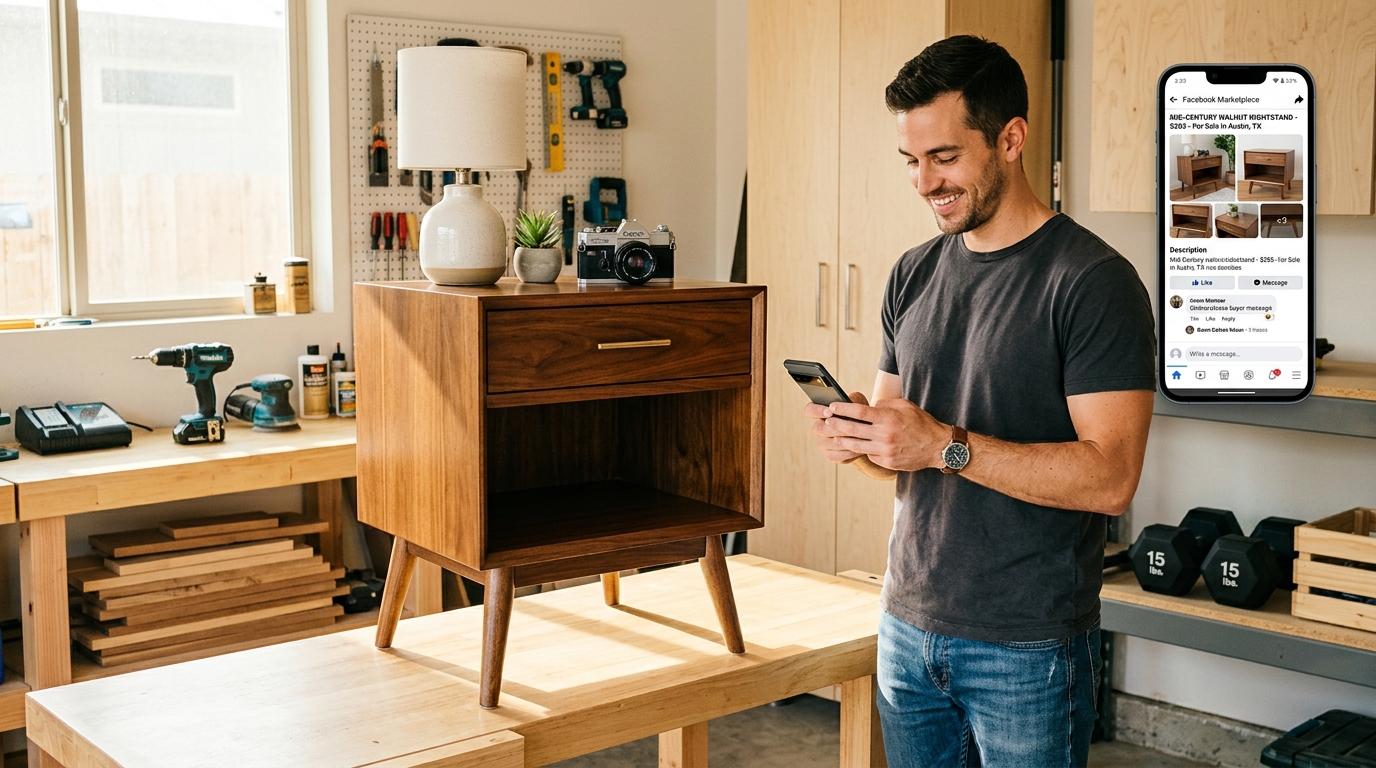
Solid Hardwood Furniture: Mid-century modern nightstands, oak coffee tables, and pine dressers. Verify solid wood construction by inspecting dovetail drawer joints, back panel screw patterns, and end-grain edges. Avoid compressed particleboard and paper-laminate veneers, which lack structural durability and command near-zero resale value.
Commercial Power Tools & Landscaping Gear: Bare cordless tools from professional trade brands (DeWalt 20V Max, Milwaukee M18 Fuel, Makita 18V LXT) and commercial-grade small engines (Honda HRX lawnmowers, Stihl weed trimmers). Test motor brushes and battery terminal voltages on site. Power tools boast massive liquidity, routinely converting to cash within 48 hours of listing.
Brand-Name Juvenile Gear & Strollers: Premium strollers (UPPAbaby Vista, Bugaboo, Baby Jogger City Mini) frequently sell for $800 to $1,200 brand new. Parents routinely list outgrown models for $75 to $150 to clear hallway space. A 20-minute automotive upholstery steam clean elevates these units back to $350 to $500 market value.
Vintage Analog Audio & Musical Gear: 1970s stereo receivers (Pioneer, Marantz, Sansui, Yamaha) and brand-name electric guitars (Fender, Squier Classic Vibe, Epiphone). Estate liquidators frequently assume vintage receivers are obsolete junk because they lack Bluetooth, allowing you to acquire a $300 Marantz receiver for $35.
Cast Iron Cookware & Countertop Mixers: Vintage American cast iron skillets (Griswold, Wagner Ware) and KitchenAid Artisan stand mixers. KitchenAid mixers purchased for $50 with a squeaking planetary gear can be re-greased with food-grade lubricant for $8 and resold for $180.
Typical Spread: Acquire at $20 to $60, restore in 20 minutes, liquidate for $120 to $280
“You do not make your money when you sell an item; you make your money when you buy it. If you negotiate the correct entry price, the exit profit takes care of itself.”
3. Zero-Cost Sourcing Channel 2: Municipal Curb Alert & Bulk Trash Scavenging
The most lucrative secondary market procurement channel requires zero initial capital outlay: harvesting discarded high-grade assets placed on curbsides for municipal bulk trash pickup. In affluent suburban communities, homeowners routinely set solid wood furniture, patio sets, brass lamps, and bicycles on the curb simply because they remodeled their interior or lack the physical transport to haul items to a donation depot.
To execute curb harvesting systematically, download your municipal public works department’s published bulk trash collection calendar. High-income residential subdivisions typically have designated quarterly or monthly heavy trash pickup dates. Scout these neighborhoods precisely between 6:30 PM and 8:30 PM on the evening immediately preceding collection day.
When approaching a curb specimen, execute a strict 5-minute triage audit. Inspect all furniture seams with an LED flashlight to confirm the complete absence of biological contamination (such as bedbugs or pet odor). Avoid upholstered sofas and fabric mattresses entirely.
Focus exclusively on hard non-porous surfaces: solid oak tables, cast iron outdoor benches, architectural mirrors, and bicycles with minor chain rust. Because your cost of goods sold is precisely $0.00, your gross profit margin on every transaction sits at a pure 100%.

From a legal standpoint, harvesting discarded property from the public curbside is firmly protected under federal constitutional law. In the landmark United States Supreme Court ruling California v. Greenwood, 486 U.S. 35 (1988), the Court established that when property is deposited on or adjacent to a public street or curb for municipal collection, the original owner forfeits all reasonable expectation of privacy and property rights, placing the items squarely in the public domain.
However, operators must respect private property boundaries: never enter private driveways, fenced side yards, or porches without express homeowner permission. Restrict your scouting strictly to items situated directly on the municipal street easement.
Salvage Economics: $0 acquisition outlay yields $50 to $160 in net cash upon cleanup
4. Discount Decay Sourcing Channel 3: Estate Sale Liquidation Dynamics
Professional estate liquidators operate under strict contractual deadlines: their primary legal mandate from the property executor is to completely clear the residence within 72 hours so the real estate can be sold. This operational urgency creates an predictable pricing decay cycle that savvy secondary market flippers exploit systematically:
Day 1 (Full Retail Tag Price): Antique dealers and collector specialists line up at 7:00 AM. Avoid buying on Day 1 unless you identify a severely mispriced, five-figure rarity. The margins for flippers on Day 1 are almost always too thin.
Day 2 (25% to 30% Mandatory Discount): The crowd thins out significantly. Mid-tier tools, power equipment, and durable kitchen goods remain on the floor. Begin making strategic inquiries on bulk lots.
Day 3 (50% to 75% Blowout & Box Lots): This is where commercial secondary flippers generate extreme margins. Arrive three hours before the estate sale officially concludes. Professional liquidators dread having to pay trash haulers to dispose of unsold inventory.
Deploy the Box Lot Strategy: gather 10 to 15 unpriced tools, brass hardware fixtures, vintage cameras, or hand planes into a cardboard box, walk to the cashier table, and offer a crisp $25 or $30 cash payment for the entire container. Estate liquidators accept bulk cash offers in over 80% of Day 3 trials.
A specialized sub-discipline within estate sale sourcing is precious metals and mid-century lighting identification. Estate liquidators frequently overlook sterling silver hollowware and flatware, mistaking authentic pieces for electroplated nickel silver. Carry a 10x jeweler’s loupe and inspect item undersides for the word ‘Sterling’, ‘925’, or British hallmarks (the lion passant mark).
Conversely, marks stamped ‘Insignia’, ‘IS’, ‘Community’, or ‘EPNS’ signify silverplate, which carries negligible resale demand. For solid brass mid-century lamps and hardware, carry a small neodymium magnet: if the magnet adheres firmly to the lamp body, the piece is brass-plated steel; if the magnet drops off completely, it is solid cast brass, commanding a 4x resale premium once polished with Brasso.
Estate Rule: Day 3 box lot negotiations consistently yield 85% discounts against fair market value
5. The 30-Minute Workshop Refurbishment Playbook
The single greatest operational trap in furniture flipping is over-restoration. Novice flippers spend twenty hours stripping paint, sanding bare wood, applying three coats of polyurethane, and replacing drawer slides on a $30 nightstand, effectively earning an abysmal wage of $4 per hour. Professional flipping mandates the 80/20 Refurbishment Protocol: invest no more than 30 minutes of manual labor per item using rapid restorative chemistry.
Acquire three foundational shop supplies: a can of Howard Restor-A-Finish (in Walnut and Golden Oak, $11), a pack of grade 0000 ultra-fine steel wool ($6), and a jar of Howard Feed-N-Wax beeswax conditioner ($10). When applied to scratched, sun-faded, or water-stained solid wood surfaces, Restor-A-Finish penetrates through the existing lacquer finish, blending out white cup rings and surface scratches without dissolving the original finish.
Buffing the surface dry and applying Feed-N-Wax restores the deep amber glow of vintage wood in exactly 15 minutes. For metals, plastic casings, and appliance housings, deploy Krud Kutter degreaser and melamine foam sponges (Magic Erasers) to eliminate years of accumulated grime in a single wipe-down.
Chemistry Tooling: $27 in restorative supplies cleans and revives over 20 furniture pieces
6. Staging, Photography, and Algorithm Optimization
A $200 solid wood credenza photographed in a dark, cluttered garage next to garbage cans and lawn fertilizer will struggle to sell for $50. The identical piece staged against a clean, neutral interior wall with a small potted plant and an accent lamp will sell for $220 in six hours. You are not merely selling physical furniture; you are selling visual interior aspiration.
Execute the 10-Photo Listing Protocol using your smartphone: wipe down your camera lens, stage the item against a clean wall with abundant indirect natural window light, and shoot one wide hero portrait shot, four 45-degree angle perspectives, two close-up drawer joint images, one shot documenting the maker’s brand stamp, and two close-ups transparently highlighting any minor authentic wear or patina. Transparently showing small scratches builds immense buyer trust and prevents awkward haggling at the point of sale.
Optimize your listing title for local search algorithms. Never write vague titles like ‘Nice Wooden Dresser’. Craft exact keyword-dense headlines: ‘Solid Oak 3-Drawer Dresser – Mid Century Modern Danish Style – Dovetail Drawers’. In the description body, state the exact width, depth, and height in inches, declare ‘Cash or Venmo at local pickup’, and specify whether the item fits into an SUV trunk.
Staging Lift: High-clarity natural lighting photos command a 35% to 60% price premium
7. Cash Settlement Security and Federal Tax Compliance (IRC Schedule C)
Managing peer-to-peer cash transactions requires uncompromising personal security protocols. Never invite unfamiliar prospective buyers inside your private residence. Establish a strict Safe Trade Zone policy: execute all transactions during daylight hours in the public parking lot of your local municipal police station (many precincts feature designated ‘Safe Exchange Zones’ under 24/7 video surveillance) or outside a high-traffic grocery store or bank branch.
Always inspect physical currency before releasing merchandise. Carry a $6 iodine counterfeit detector pen and check watermarks against natural light on all $50 and $100 banknotes. If accepting digital peer-to-peer payments (such as Venmo, Zelle, or Cash App), confirm that the funds have cleared directly inside your official banking application before the buyer departs; never trust a buyer showing you a screenshot on their personal screen.
From a regulatory standpoint, secondary market flipping constitutes active trade or business income under Internal Revenue Code Section 162. Income generated from flipping physical goods must be reported on IRS Schedule C (Form 1040).
Maintain a meticulous digital spreadsheet recording your acquisition date, original purchase price, receipt costs for restoration supplies (steel wool, wax, sandpaper), vehicle mileage driven for sourcing runs (deductible at the standard federal business rate of 67 cents per mile), and final gross sale proceeds. Proper bookkeeping ensures complete compliance while maximizing legitimate business write-offs.
Compliance Standard: Maintain receipt records for all inventory purchases and restoration supplies
| Secondhand Product Category | Typical Sourcing Cost | Restoration Labor & Supplies | Realistic Resale Price | Net Cash Profit | Turnaround Velocity |
|---|---|---|---|---|---|
| Solid Oak / Pine Nightstands (Pair) | $25.00 (Garage Sale) | $4.00 (Restor-A-Finish / 20 min) | $125.00 | $96.00 | 3 to 6 Days |
| Curb Scavenged Mid-Century Desk | $0.00 (Bulk Trash Route) | $6.00 (Beeswax & Glides / 30 min) | $110.00 | $104.00 | 2 to 5 Days |
| Cordless Power Tool Bare Tool (DeWalt) | $20.00 (Estate Sale Day 3) | $1.00 (Degreaser Wipe / 5 min) | $75.00 | $54.00 | 1 to 3 Days |
| Premium Jogging Stroller (City Mini) | $40.00 (Marketplace Moving) | $5.00 (Steam Clean / 25 min) | $185.00 | $140.00 | 4 to 7 Days |
| Cast Iron Skillet (Griswold #8) | $12.00 (Estate Sale Box Lot) | $3.00 (Grapeseed Oil / 40 min) | $85.00 | $70.00 | 5 to 8 Days |
| Vintage Audio Receiver (Pioneer / Sansui) | $30.00 (Estate Liquidation) | $4.00 (DeoxIT Cleaner / 15 min) | $195.00 | $161.00 | 2 to 4 Days |
| Total Monthly 6-Item Portfolio | $127.00 Total Invested | $23.00 Supplies (2.2 Hrs) | $875.00 Gross Sales | $725.00 Net Cash | Rapid Capital Turnover |
Status: Field Proven Arbitrage
🧰 Our 5-Point Weekend Flipping Starter Protocol
Point 1: Download your local municipal heavy trash collection map and schedule your first 45-minute evening curb scouting run through an affluent residential zone.
Point 2: Assemble your $27 mobile restoration kit: one can of Howard Restor-A-Finish, grade 0000 steel wool, Feed-N-Wax, microfiber rags, and a counterfeit detection pen.
Point 3: Establish your dedicated Safe Trade Zone location outside your local police department or regional bank branch with active surveillance coverage.
Point 4: Enforce the 3x Gross Margin Hurdle: never buy inventory on speculation without documented local sold comparable listings.
Point 5: Reinvest 70% of your net profits into higher-value, compact inventory items to scale your working capital without cluttering household living areas.
🏛️ Primary Sources & Regulatory Disclosures
- Official Source: U.S. Consumer Product Safety Commission (CPSC) — Product Safety Recall Database
- Official Source: Internal Revenue Service — Instructions for Schedule C (Profit or Loss From Business)
- Official Source: Federal Trade Commission — Safe Peer-to-Peer Payment Practices and Fraud Protection
Editorial Note: Komon Lab publishes independent consumer and side-hustle educational research. Before purchasing or reselling juvenile furniture, infant car seats, or electrical goods, always audit the CPSC recall database to verify compliance with federal consumer safety mandates. When meeting prospective buyers, always prioritize personal safety in public, illuminated venues.
⚖️ Operational Disclosures & Local Commerce Regulations
Komon00 is an independent personal finance educational platform. We do not provide individualized commercial, tax, or legal advisory services. Resale profit benchmarks cited in this guide reflect empirical secondary market observations across standard metropolitan US territories. Net earnings fluctuate based on local consumer demand, seasonality, condition, and negotiation dynamics. Operators are advised to consult a qualified tax professional regarding state sales tax permits, municipal home-business regulations, and federal self-employment tax filings.